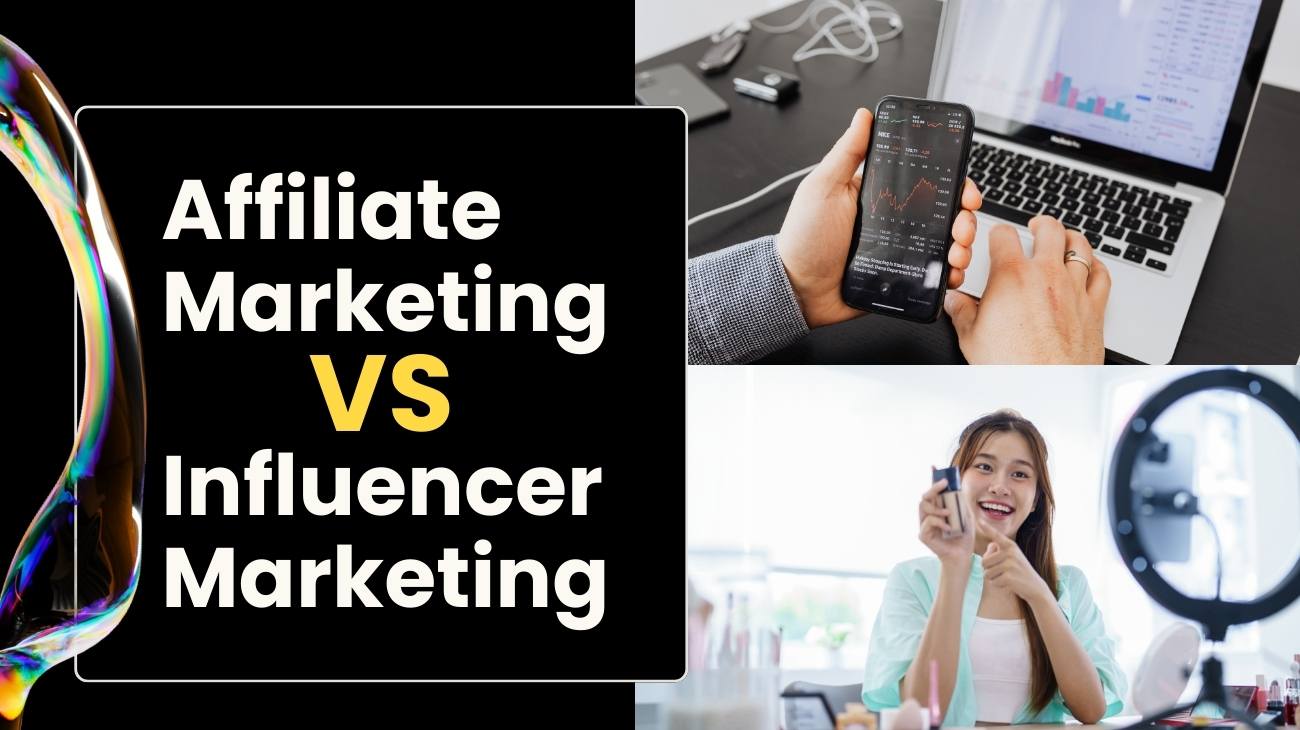
The affiliate marketing continues to drive around 16% of all eCommerce sales in the U.S., while the global influencer marketing industry reached $21.1 billion in 2023(Statista). Clearly, both strategies are shaping how brands attract, engage, and convert customers in 2025.
Yet despite their popularity, many marketers still struggle to decide which approach delivers better results — affiliate marketing vs influencer marketing. One is built on performance and precision; the other thrives on trust and storytelling.
In this guide, we’ll break down how each model works, where they differ, and which one fits your brand best. You’ll also see how leading businesses are now combining both to build credibility, drive measurable ROI, and scale faster in the digital economy.

What Is Affiliate Marketing?
Affiliate marketing is a performance-driven strategy where brands reward partners—known as affiliates—for driving specific, measurable actions (such as sales or leads) via tracking links and commission payouts. In essence, affiliates promote a product or service, the audience takes an action, and the brand pays only for successful conversions.
Key components:
- Unique tracking links or codes that attribute the sale or lead to the affiliate.
- A commission structure (flat fee or percentage of revenue).
- An affiliate network or in-house program that manages tracking, payouts and compliance.
- Performance metrics (clicks, leads, sales) enabling clear ROI measurement.
Why it matters
1. The global affiliate marketing industry was estimated at US $18.5 billion in 2024 and is projected to grow to US $31.7 billion by 2031.
2. Over 80% of brands are already leveraging affiliate marketing programs to drive sales.
3. In the U.S., affiliate marketing contributes to about 16% of e-commerce orders.
These statistics highlight that affiliate marketing is not just a fringe channel—it’s a mainstream conversion engine. For digital marketers, eCommerce owners or SaaS founders, this means affiliate marketing offers scalability, measurability, and a direct link to sales outcomes.
Where it works best
Because of its ROI-focused model, affiliate marketing is especially useful when:
- You have a product with clear conversion (eCommerce purchase or SaaS signup).
- You can provide affiliates with effective tracking and attribution tools.
- You’re comfortable with a partner-based model and somewhat less direct control over messaging.

What Is Influencer Marketing?
Influencer marketing is a relationship-driven strategy where brands collaborate with individuals—known as influencers—who have built a loyal following on platforms like Instagram, YouTube, or TikTok. These influencers use their credibility and connection with their audience to promote a brand’s product or service authentically.
Unlike affiliate marketing, which focuses on performance-based results, influencer marketing emphasizes awareness and trust. It’s about storytelling, product experiences, and emotional resonance that builds brand recognition rather than immediate conversions.
Key components:
- Sponsored content across social media platforms (posts, videos, stories, or live streams).
- Collaboration formats like product reviews, tutorials, giveaways, and ambassador partnerships.
- Compensation models ranging from flat fees and product exchanges to hybrid performance bonuses.
- A strong focus on engagement metrics such as reach, impressions, and comments instead of direct sales.
Why it matters
According to Statista, the global influencer marketing industry was valued at $21.1 billion in 2023, reflecting how quickly it has become a core marketing channel for brands worldwide.
This growth signals that influencer marketing is no longer a trend—it’s an essential part of brand communication. For digital marketers, eCommerce owners, and SaaS founders, it provides a powerful way to build credibility, engage target audiences, and create authentic brand experiences.
Where it works best
Influencer marketing delivers the strongest results when:
- You’re launching a new product and want to build awareness fast.
- Your audience values authenticity and peer recommendations.
- You aim to spark engagement and emotional connection rather than immediate sales.

Affiliate Marketing vs Influencer Marketing — Key Differences
While both affiliate and influencer marketing aim to increase brand reach and revenue, they function through different mechanisms.
Affiliate marketing focuses on measurable performance. Brands pay affiliates only when a sale, lead, or specific action occurs. It’s data-driven, predictable, and ideal for conversion-focused campaigns.
Influencer marketing, on the other hand, is built on relationships and visibility. Brands collaborate with influencers to leverage audience trust and credibility, paying for exposure rather than direct results.
Affiliate Marketing vs Influencer Marketing — Key Differences
Aspect | Affiliate Marketing | Influencer Marketing |
Payment Model | Commission-based — brands pay affiliates for each verified sale, lead, or action. | Upfront fees or product-based partnerships — payment for exposure or content creation. |
Goal | Focuses on measurable conversions and ROI. | Focuses on awareness, credibility, and audience engagement. |
Control | Affiliates follow performance guidelines and tracking rules. | Influencers have creative freedom to tell authentic stories. |
Scalability | Easily scalable through affiliate recruitment and automation. | Scales through selective collaborations and content reach. |
Metrics | Clicks, leads, and sales conversions. | Engagement rate, impressions, and audience reach. |

Which Is Better for Your Brand? (Use Cases by Business Type)
Choosing between affiliate and influencer marketing depends largely on your business model, customer journey, and growth goals. Each approach shines in different contexts — and in many cases, the strongest strategy blends both.
For eCommerce Businesses
For eCommerce, affiliate marketing often wins because it drives consistent, measurable sales.
With clear product catalogs and frequent promotions, affiliates can easily create content — from product reviews to coupon sites — that generates repeat purchases.
Data also supports this: according to Statista, affiliate marketing accounts for roughly 16% of all eCommerce sales in the U.S., underscoring its effectiveness in performance-based retail growth.
For SaaS Companies
In the SaaS world, affiliate programs help build predictable, recurring revenue.
Partners who understand the product’s value can drive qualified leads and long-term customers. Since SaaS pricing is subscription-based, affiliate payouts tied to recurring revenue (MRR) make the channel highly sustainable.
Additionally, affiliates often serve as niche educators—bloggers, tech reviewers, and consultants—who can explain the product benefits far better than traditional ads.
For Lifestyle or DTC Brands
For lifestyle, fashion, beauty, or DTC brands, influencer marketing performs better.
These audiences value authenticity, aesthetics, and emotional resonance — all areas where influencers excel. A single creator’s endorsement can shape perception and build community faster than performance-driven affiliate links.
Micro- and nano-influencers, in particular, drive engagement rates up to 60% higher than macro-influencers (Impact.com, 2024), making them ideal for storytelling-driven brands.
The Hybrid Approach
For most brands, the sweet spot lies in combining both models.
Influencers can create awareness and trust at the top of the funnel, while affiliate partners convert that attention into measurable sales.
This hybrid system ensures both visibility and accountability — blending storytelling with performance for long-term brand growth.

How to Combine Affiliate and Influencer Marketing for Maximum ROI
Blending affiliate and influencer marketing lets brands build trust and trackable performance. The idea is simple — use influencers’ credibility to attract audiences and affiliate tracking to convert them.
1. Turn Influencers into Affiliates
Invite influencers to join your affiliate program. Instead of paying a flat fee, offer commissions for each sale or lead. This motivates creators to produce content that converts while giving brands measurable ROI.
2. Use Unified Tracking Tools
Platforms like Impact, Refersion, or PartnerStack track influencer-driven sales and automate payouts. According to HubSpot (2024), brands using both influencer and affiliate models see up to 30% higher ROI than those relying on one channel.
3. Build Long-Term Partnerships
Reward high-performing influencers with tiered commissions or bonuses.
When influencers feel invested, they become loyal advocates who consistently promote your products.
4. Prioritize Authentic, Conversion-Focused Content
Encourage creators to blend storytelling with clear calls to action — discount codes, tutorials, or reviews that drive real clicks and conversions.
Final Thoughts
Both affiliate marketing and influencer marketing can deliver strong results — but in different ways.
Affiliate marketing drives measurable performance, helping brands scale sales with predictable ROI. Influencer marketing builds trust and awareness, strengthening brand perception through authentic storytelling.
Rather than choosing one, many successful brands now combine both. Influencers generate awareness at the top of the funnel, while affiliate partners convert that attention into sales.
This hybrid strategy ensures your brand benefits from credibility, reach, and measurable growth — all working together toward long-term success.
Ready to grow smarter with data-driven marketing strategies?
Tech Insider Talk brings you expert insights, guides, and comparisons that help you stay ahead in today’s digital world.
Whether you’re a marketer, founder, or eCommerce owner — this is where strategy meets execution.
Subscribe to Tech Insider Talk and get actionable marketing intelligence delivered straight to your inbox.

FAQs About Affiliate Marketing vs Influencer Marketing
1. Can a brand use both affiliate and influencer marketing together?
Yes. Many brands combine both — using influencers for awareness and affiliates for conversions. This hybrid model ensures visibility at the top of the funnel and measurable ROI at the bottom.
2. Which is better for startups with small budgets?
Affiliate marketing is generally more cost-effective because you only pay for actual results. It’s a lower-risk option for brands that need predictable spending and clear ROI tracking.
3. How do you measure success in influencer marketing?
While affiliate marketing tracks sales and clicks, influencer marketing success is measured through engagement, reach, and audience sentiment. UTM links and discount codes help improve attribution accuracy.
4. What industries benefit most from each approach?
Affiliate marketing works best for eCommerce, SaaS, and subscription-based businesses.
Influencer marketing thrives in lifestyle, fashion, beauty, and tech — where trust, aesthetics, and community engagement matter most.